The Pretenders are dead, long live the King of DMS

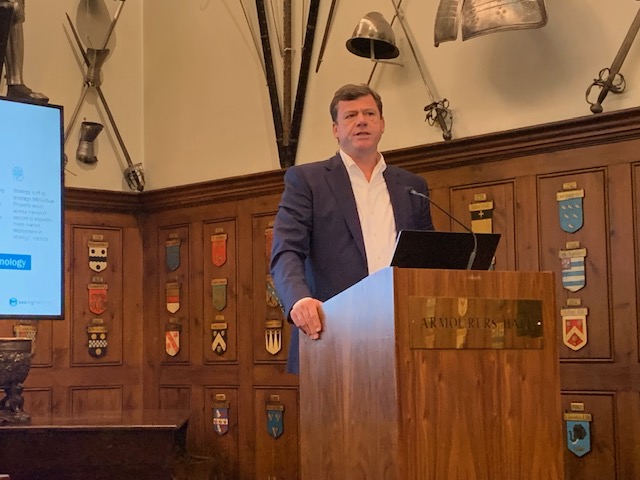
At yesterday’s Capital Markets Day for Seeing Machines it was standing room only, as Colin Barden an independent analyst at Semicast Research presented the news that investors in Seeing Machines have long waited to hear: though the coronation has been delayed, it will be the King of DMS.

It was hard news for rivals but, in one slide, Barnden presented his projections for the market shares come 2022. He estimates 40-45% for Seeing Machines, followed by 15-20% for Mitsubishi Electric. All other rivals are left lagging far, far behind, with Smart Eye in particular estimated at 5-7%.

That said, I saw no evidence of complacency from the Seeing Machines staff, quite the reverse. McGlone, in particular, came across as a man determined to deliver profitable growth. He certainly doesn’t look like the sort of guy who will let a rival eat his lunch.

Paul McGlone, CEO, Seeing Machines

Paul McGlone, CEO, Seeing Machines

The growing interest in its DMS technology was clear from the host of analysts I met at the event: Sanjay Jha of Panmure Gordon, Lorne Daniel at FinnCap, Caspar Trenchard at Canaccord Genuity and even one from Steifel (there may well have been others). I’m sure the house broker Cenkos was represented but house analyst Jean-Marc Bunce was the invisible man on this occasion.

Fleet

Probably, a wise decision on Bunce’s part as I’ve been trying to find out why he’s taken such a conservative stance on fleet. In his note dated 23rd September he states on page 1: “We believe the guidance for 27-30k connections at the end of FY20 is conservative and underpinned by a strong pipeline.ā€

Yet on page 4, he contradicts this, becoming ultra conservative, when he writes:Ā ā€œā€¦.our Fleet connection forecasts are based on connections below the guidance of 27-30kā€.

I wondered why he decided to do this and also upon what number of fleet connections he actually based his projected revenue figure of A$20.9m? By my calculations to arrive at A$20.9m he must have used less than 18,000 installations, which does appear excessively low.

Yesterday the new CEO, Paul McGlone was in combative mood as he faced down attempts to extract projections on the number of Fleet sales for 2020, sticking to guidance of 27-30k. He even declined to provide a current figure. I assume this is because Seeing Machines hopes to upgrade at the interims and doesn’t want to spoil the surprise. Personally, I don’t particularly like surprises even to the upside.

The reduction in the unit cost of Gen 2 Guardian by 21% announced yesterday must surely drive increased uptake from fleets as will the increasing number of distributors and deals with insurers.

Mike Lenne, the Human Factors expert who heads up Fleet does appear to be its secret weapon when it comes to persuading Fleets to use their technology to improve safety. HIs calm, analytical approach should pay dividends and puts Seeing Machines in a league of its own.

It was the first time I’ve met Tim Edwards, one of the original brains behind the technology along with fellow co-founder of the company Sebastien Rougeaux. Edwards comes across as a very modest man, particularly for a genius who jointly developed this life-saving technology.

Aviation

While CEO McGlone and Pat Nolan, who heads up Aviation, were chided slightly for building up expectations re. an aviation licensing deal with CAE and L3 Harris, I got the impression such a deal is at most a 2-3 months away. We’ll see I guess. The great news is that end users (such as Alaska Airlines) are now requesting that manufacturers of full flight simulators now have eye-tracking from Seeing Machines.

Auto

As for Nick DiFiore, who heads up Auto, I’m expecting him to deliver a lot. Volvo for one, VW for another pretty soon. Followed by Japanese OEMs. Oem decision-making has been the main reason for delays up to this point but See does appear remarkably well positioned with Xilinx to grab market share from Nvidia and Mobileye. The fact that Fovio can identify an incapacitated driver makes it a shoo-in for Volvo and parent Geely may well have decided it needs it too.

The US market really needs to hear this in its own accent and so it was good to be told by Paul McGlone that it will be getting a US broker. I do hope it is Morgan Stanley. I’ve long wished to read/hear Adam Jonas extol the virtues of Seeing Machines.

Overall then, while I would have liked more opportunity and time for detailed questions, I feel that further patience will be handsomely rewarded here. Of course, every investor should do their own research.

The writer holds stock in Seeing Machines.

CAT-style Aviation licence deal is coming

The announcement by Seeing Machines that it is collaboratingĀ with Alaska Airlines is significant as it underlines its intention to extract value from its leadership position in this niche of the Aviation market.

In a note issued today by house broker Cenkos, analyst John-Marc Bunce reiterated Seeing Machines’ determination to sign a CAT-style license agreement with two major aviation simulator manufacturers.

Bunce wrote: “With Seeing Machines many years ahead of its nearest rival in this sector, it is looking like the company could be in a strong negotiating position in discussions with the two major simulator manufacturers for a license. We believe a successful outcome could include an upfront payment as well as a value driven or recurring royalty element.”

It doesn’t require too much detective work to find out who these two are likely to be but, as I don’t want to prejudice any final negotiation or comms plan, I’ll avoid speculating publicly for the time being.

Such a deal should certainly bring forward breakeven and act as a catalyst for a significantĀ re-rating. This is before the announcement of further auto OEM auto wins in Europe — never mind Japan.

The writer holds stock in Seeing Machines

Time to re-rate SEE 2.0

Seeing Machines’ (AIM: SEE) full year results indicated strongly that the issues that affected its fleet division are fixed and I expect news flow over the next few months to drive a significant re-rating.

In a note issued yesterday, house broker Cenkos upgraded its price target to 12p. Analyst John-Marc Bunce explained: ā€˜We believe the turnaround in fleet will drive the company to profitability in under 2 years with the cash runway looking sufficient even before accountingĀ  for licensing deals or financing against recurring revenues.ā€

This was reiterated in a webcast from CEO Paul McGlone today in which he assured investors: “Fleet is fixed and starting to perform”. He added that there were no plans for a dilutive equity fundraise in his 3-year plan. Moreover, an aviation licence deal (expected to happen before year end) would effectively mean the company is funded to profitability.

Fortunately, the new CEO seems to have pressed the reset button and confirmed that over the past 6 months he has made significant changes: “The business is now focused on profitable revenue, we don’t chase strategic business.”

Cenkos has pencilled in a conservative (how I dislike that word) A$47.5m revenue figure for the full year to June 2020, with a pre-tax loss of A$35.9m. Thereafter losses fall in 2021 to A$10.6m and SEE reaches profitability in 2022 (A$47.5m).

I think these estimates will be revised over the course of the coming year, bringing forward breakeven by at least a year.

After so many years of disappointment and failure to deliver against financial targets I think this will be a transformational year for Seeing Machines. It will hinge on these 3 things happening:

  1. Acceleration in the installation of Guardian in fleets and cheaper units produced in H2.
  2. More auto OEM contract wins.
  3. Aviation licence deal by the year end.


Positives

Fortunately, signs look good for all three.

  1. Fleet growth should accelerate further this year as Cenkos confirms: ā€œWe believe the guidance for 27k-30k connections at the end of FY2020 is conservative and underpinned by a strong pipeline.ā€ Moreover, the unit costs of Guardian are due to come down significantly from the the second half of this financial year, driving more profit. In addition, McGlone today revealed that SEE is expecting solid growth in the US market.
  2. I’m expecting two existing US customers to extend their existing contracts and Seeing Machines to win two more OEMs in Europe very soon. This is aside from continued progress in Asia over the course of this financial year.
  3. We now know (after the webcast) that Aviation licence deals are coming soon. That will improve the bottom line without involving significant risks and costs.

Lest we forget, there is also a bigger game afoot, as Bunce pointed out in his note:

ā€œā€¦ one could argue that Seeing Machines has greater strategic value than Mobileye has as we highlight the ever-increasing importance for reliable face, eye and emotion tracking in the real world for many applications beyond automotive and transportation; from retail, medical, personal robots and personal computing devices. This value would be seen not just but major chip and software platform providers like Intel, but also the world’s tech giants.ā€

I’d advise all investors to do their own research and the above is my opinion only.

The writer holds stock in Seeing Machines.
Long live the King of the DMS

In a recent note from Redeye, its analyst commented that whoever wins VW or Toyota in the second half of the year will be ā€˜King of DMS’. He seems to think it may be Smart Eye, whereas I’m convinced it will be Seeing Machines that wins both.

I also believe Smart Eye will soon suffer the embarrassment of Volvo choosing Seeing Machines for its 2021 flagship XC90’s DMS.

Certainly, after a successful fundraise Smart Eye looks ā€˜strong and stable’ but as the British electorate knows only too well, the truth will out. Propaganda eventually has to give way to reality. That time has arrived for Theresa May and will very shortly arrive for Smart Eye. Tick tock.

Enough of analogies, Smart Eye even as number 2 will have its share of the cake that SEE doesn’t want. China is a big market and I wish it well there. I just hope Chinese consumers don’t take a ride in Byton’s M-Byte when it launches later this year — it features SEE’s superior DMS.

I also believe that the BMW X5 and Audi A8 will revert to Seeing Machines – for as the Beatle song Drive My Car, could have said:Ā  ā€˜Using a DMS at up to 37mph is all very fine, but I can show you a better time’.

In the auto world premium means ā€˜the best’. In a very competitive market Audi and BMW can’t afford to look like chumps v. Mercedes when it comes to safety. That is why auto OEMs are telling, yes telling, Tier 1s to use Seeing Machines technology.

Some will naturally dispute what I’m saying. Still, let those with ears to hear, hear.

The writer holds stock in Seeing Machines.

Silver lining in a cloud of investor misery?

Following today’s news that Seeing Machines is having a deeply discountedĀ  conditional placing and subscription to raise Ā£27.5m, the management of the company seems to have lost both the goodwill and trust of many private investors.Ā 

Indeed, the fact SEE couldn’t get even get a placing with existing institutional investors away at 5pĀ tells youĀ a lot.

It’s quite frankly shocking that the company had to offer shares at 3p in order to raise cash and follows a long series of fleet and train related mishaps that Chris Grayling would be proud of.

The only silver lining I can see is that with the expected OEM wins still to be announced it becomes a sitting duck for an opportunistic bid. My sources tell me that last year, after numerous ā€˜discussions’, it came close to being snapped up by Bosch for around 17p. Well, I dare say, it is still available at a knock-down price.

Anyone want a to buy a company with great tech but poor management? 10p? Anyone? 7.5p?

UPDATE

For those investors despairing tonight, I’ve some hope. Ironically it comes from house broker Cenkos who put out a note today. Analyst Jean-Marc Bunce clearly cares about his reputation and though he loweredĀ the price target to 9p,Ā Bunce can’t help but admit on page 15:

“Strategic value is significant – 39p at 8% discount rate

To demonstrate the significant value in the increasingly visible future cash flows from Seeing Machines’ automotive license fees, we note that a large organisation with a market average Beta of 1 would have an equity cost of capital of 8%. At an 8% cost of capital our valuation for Seeing Machines rises to 39p and we note the weighted average cost of capital for a large corporate would likely be even lower through debt financing.”

In fact, the more times I read this note the more I get the sense thatĀ it is setting out a case for SEE being sold at a particular price. We’ll see.

The writer holds stock in SEE.

eServGlobal: M&A thoughts

FinnCap, the house broker for eServGlobal, has published a note highlighting the accelerating pace of M&A activity in the payments industry and its implications for the AIM-listed minnow.

There have been 3 big mergers so far this year in the payments industry:

  • Ā  Fiserv’s acquisition of payments processor First Data for $22bn;
  • Ā  Visa’s acquisition of Earthport for Ā£200m; and
  • Ā  Worldpay acquisition of FIS for $43bn.

In addition, after missing out in the Earthport auction, Mastercard has bought Transfast. This prompted EservGlobal to issue an RNS today in which it stated: ā€œTransfast is a network partner of HomeSend, offering reach and connectivity principally into Africa and Latin America, together with foreign exchange and ancillary services. Network relationships are a critical element of HomeSend’s services and HomeSend continues to grow these partnerships throughĀ several regional network partners, such as Transfast, together with HomeSend’s own direct connections, to deliver across multiple markets and channels.ā€

FinnCap Director of Research Lorne Daniel explained: ā€œAfter missing out in the Earthport auction, Mastercard has bought Transfast. We see this as augmenting not replacing HomeSend. The Transfast acquisition will augment Mastercard’s well-defined and established strategy to dominate global payments with a range of solutions. Purchasing one of the technologies underlying Mastercard Send gives greater control, adding capacity as well as reach.ā€

Daniel noted: ā€œWe continue to expect Mastercard to seek full control (from its current 64.31%) of HomeSend, which it continues to flag as a key platform to dominate international Account-to-Account and Business-to-Business transfers. Indeed, the recent surge in M&A activity in the segment should hasten that move.ā€

Daniel currently has a target price of 20p on the share.

The writer holds stock in eServGlobal.

Seeing Machines wins strategic FCA contract estimated at US$200m

Seeing Machines has won the contract to supply US carmaker Fiat Chrysler (FCA) with its Fovio chip Driver Monitoring System, as predicted here months ago.

Ostensibly it is a US$6m contract (for Jeep or Ram, I believe) but as we all know the value is likely to end up far higher as DMS is swiftly rolled out across all its various car marques and models.

My estimate for the eventual worth of this deal is nearer to the hundreds of millions of US dollars. FCA produces 4m cars a year. Within 3 years I expect the Fovio chip to be in approximately 50% of them, say 2m cars. At US$20 a pop (volume discount from US$30) that is at least $40m a year. EVERY YEAR from 2022!

As the lifetime of a model is 5 years, my belief is that this strategic contract should end up being worth at least US$200m.

Clearly FCA couldn’t afford to let Ford with its F-150 pick-up outcompete in the premium DMS arena. They just had to have it.

I feel a twinge of sympathy for Smart Eye who at one stage hoped to win FCA. Indeed, as i believe the Tier 1 is Aptiv Seeing Machines are rubbing salt intoĀ its wounds — it is the equivalent of your partner running off with your worst enemy.

Unfortunately, Smart EyeĀ don’t have an automotive grade chip, although they are trying to develop one. Unfortunately for them, Seeing Machines has already passed the finishing line where the US premium auto OEMs are concerned. After all it has now bagged FCA, Ford and GM.

In additionĀ theĀ next raceĀ has nearly been won in Europe where it will win VW to add to BMW and Mercedes and I don’t expect the result to be any different in Japan (Toyota and Honda are coming I believe).

This latest win brings an eventual bid for Seeing Machines much, much closer. So far as DMS is concerned SEE really is the next Mobileye. Indeed, I imagine the calculations I’ve roughed out will be replicated by many chip companies.

The writer holds stock in Seeing Machines.

SEE is worth over £1 a share

Ridiculous as it might sound, when Seeing Machines is currently 4p a share, I believe its intrinsic value is even now well over £1 a share. This is because it will continue to dominate the automotive driver monitoring niche for the next few years at least.

Anyway, here’s my thinking in a nutshell. I’ve based my valuation on auto alone as I think that is the real driver of value with SEE (excuse that pun!).

In his note on January 16th Jean-Marc Bunce, analyst at house broker Cenkos, revealed: ā€œSeeing Machines has a far more conservative approach to announcing automotive revenue visibility that its competitorsā€.

In the note he pointed out details on the deals already done. I’ve outlined my thoughts on them here:

  • OEM 1 [General Motors] — Supercruise will be rolled out to entire range of Cadillacs (some 350,000 cars by end 2021). Thereafter, I’d expect it to go into most of GMs 10m cars.
  • OEM 2 [Mercedes] — Programme is just for its flagship S Class saloon car, equivalent to 5% of the total cars produced.
  • OEM 3 [BMW] — stated minimum contract value of USS$25m. However, BMW sells 2.3m cars a year and Fovio chip will be rolled out across the entire group.
  • OEM 4 [Ford] — F-150 is a phenomenal earner for Ford and last year Adam Jonas, the famous Morgan Stanley analyst, stated the franchise could be worth more than Ford itself. It has been estimated that Ford will is planning to produce around 1m a year of these in the future. I expect Ford will also roll it out across other car models in due course. Note that Ford produced 6.6m cars in 2017.
  • OEM 5 [Byton] — relatively small volumes but I’d expect them to grow and other premium electric cars to put Fovio into their offerings.

Imminent wins

By the end of this financial year I expect SEE to have announced wins with FCA, Volkswagen and Volvo with Toyota and probably Honda following shortly after.

Alternatively, you can gain a sense of the value of Seeing Machines auto business by looking at the macro picture. Assume 70% of cars have DMS by 2022, and SEE have at least 50% of that market, with estimated global car volumes of around 110m in 2022. If SEE received US$20 a car (blended average of Fovio selling at US$30 a chip and software at US$10) that would deliver revenues of approximately US$770m a year.

If Gen 2 Fovio can maintain pricing at US$30 a car, revenues would be nearer US$1.1bn a year. EVERY YEAR!

Then, were SEE to be sold for a Mobileye-type valuation of 42x revenues it would be worth a minimum of between US$32bn to US$46bn. Note that Mobileye sold for US$15.3bn.

Now discount that back for execution risk, meteor showers etc and even the meanest industry player would probably pay at least US$5bn (£3.6n) for its strategic value and future cash flows this year. That is about £1.50 a share from its current 4p.

I know some will say that is totally unrealistic. Still, the figures are there if you dig. It has happened before to shares with far less real value than SEE.

Takeover

But don’t worry, I anticipate that long before 2022 Seeing Machines will be bought by a huge company that does see the potential here. In any case, when SEE announces a couple more huge OEM wins (before the end of June) the price should start to appreciate substantially.

So why hasn’t it happened already? Well, I think the market has yet to catch up with reality. But the aroma of coffee is wafting inexorably towards its nose and it will wake upĀ very, very soon.

Colin Barnden, Lead Analyst at Semicast Research wasn’t keen to be drawn on the exact valuation of Seeing Machines but did explain: ā€œWhat is clear to me is no one is following the DMS market (the big investors still believe in autonomous driving at Levels 4 and 5). This will change soon enough and CES was a big step in that direction. Certainly the car OEMs are in no doubt. I think the delays have come about from the OEMs taking longer to decide which T1/T2 to use, and then rolling DMS out much faster than had been previously thought. All will be clearer by June.ā€

My fears of a low-ball bidder getting SEE on the cheap have now receded substantially, given the accelerating take up of its camera-based DMS into cars. Any such bid, if publicly acknowledged, would surely just ignite a bidding war.

The writer holds stock in Seeing Machines.

Cadillac extension gives Seeing Machines US$10m boost

News from Motor Authority that Cadillac is rolling out Super Cruise across its entire range of Cadillacs from the end of 2020 is very positive for Seeing Machines, as the system incorporates its Driver Monitoring System (DMS).

Cadillac

Global sales for Cadillac were 356,00 in 2017 and at approximately US$10 a car (only software being used not the chip, apparently), Seeing Machines can look forward toĀ initial revenues with milestone paymentsĀ of up to US$10m. Thereafter, annually it is likely to be lessĀ unless GM moves to a Gen 2 chip or extends the DMS to its entire range of cars.

The Super Cruise system, which enables safe hands-free semi-autonomous driving, was only this week voted the 2019 Technology of the year by Autoblog.

This extension across the entire Cadillac range is certainly materially important, so I’d expect a full RNS at some point. Personally, I think its the first stage in what eventually will be a roll-out across all GM cars. For, just as every car now has seat-belts, DMS is going to be mandated as an essential system around the world to prevent accidents from driver fatigue and inattention.

I’m also expecting confirmation, whether from news articles or RNS announcements, of several other huge auto OEM wins over the next few months.

Fleet

It’s also very encouraging to learn that First Bus, one of the UK’s leading bus operators, to deployĀ Guardian to numerous bus services across the UK & Ireland.

In the blog post on the Seeing Machines website (why not via an RNS?) the company revealed: ā€œFollowing an extended evaluation of at the Reading RailAir coach service, running from Reading train station to Heathrow Airport, First Bus has decided to rollout the technology further across their fleet.

ā€œPhase one of the agreement is the fit-out of GuardianĀ to a number of services in the UK and Ireland and has begun with Glasgow Buchanan Street Bus Station to Glasgow Airport. The installation across the region will comprise a mix of retrofit to existing coaches and new builds withĀ GuardianĀ pre-installed. This phase is expected to cover more than 70 buses and coaches and to be completed in early 2019.ā€

Broker notes

I look forward to Cenkos, and yes even Canaccord Genuity, soon producing updated estimates for this year and well beyond. This is because IĀ believeĀ projected revenue growth over the next 3 years, led by auto, will amaze many. Moreover, contracted revenues should grow exponentially this year, led by further deals with auto manufacturers who are keen to incorporate Seeing Machines Fovio driver monitoring technology into their cars.

The writer holds stock in Seeing Machines.

Waymo good news to come

I’m convinced Waymo has chosen to use Seeing Machines Backup Driver Monitoring System (BdMS). (As predicted by ā€œThe notorious bloggerā€ a few months ago).

This follows hints on social media, great reporting from US journalist Amir Efrati at The Information about the incorporation of a BdMS in Waymo ā€˜driverless’ vehicles and the reluctance of Waymo to refute suggestions that it is using Seeing Machines’ eye-tracking technology.

Oh, and let’s not forget an RNS issued by Seeing Machines on September 11th announcing its first BdMS win, which stated other customers were on the way.

Here’s the sentence from that RNS: ā€œSeeing Machines has signed an agreement with one customer and is in advanced discussions with a number of companies at the forefront of autonomous vehicle development.ā€

In addition, I’m expecting much more positive contract news on the OEM front in the first quarter of 2019. Plus I’m looking forward to the launch of the Byton M-Byte SUV featuring the Fovio chip in late 2019 in China (US and Europe in 2020). What a great looking car it is.

Funding concerns

Now the share price is in the doldrums and fears of a dilutive fundraise are part of the reason.

Re. funding concerns, I think Seeing Machines will probably need more cash to service this growing demand by the end of June 2019 at the latest.

Note that Jean-Marc Bunce, analyst at house broker Cenkos, stated in a note published on September 19th that there was no immediate cash requirement and that SEE had a ā€œclear cash runway through FY19.ā€

Still, he did add: ā€œOur model indicates a cash requirement of A$15-20m in FY20, based on these projections.ā€

My own thinking is that when more OEMs officially come on board, cash requirements to fund that work will be needed sooner, more likely by April 2019.

I don’t see this as a negative, provided there is little or no dilution to existing shareholders. Indeed, Seeing Machines has to grab as much OEM land as possible next year.

I believe it will succeed in the doing the latter.

Funding options

Personally, I don’t think existing institutional investors will be keen to support yet another annual fundraise before more auto OEM contracts are announced. An alternative would be to trawl round new investors but why dilute existing investors with such an unimaginative move?

A CAT-style deal for fleet, with a chunky up-front payment (say A$30-50m) would be a better option.

Alternatively, a very imaginative option might be to raise some debt via a convertible bond. I noted that the new CFO, Luke Oxenham has experience of raising cash via bond issuance. Moreover, with big company experience I’m hoping he will be willing to consider big company actions.

Logically, there must have been a reason this sentence was included in the official RNS: ā€œLuke has substantial experience of integrating business planning, business performance and capital modelling and of accessing various sources of capital from the debt and equity markets.ā€

Tesla used convertibles in 2014 to raise US$2bn. Twitter also recently used it to raise US$1bn according to Reuters.

So Luke, how about this? A 5-year convertible bond with a conversion price of 8p at around 6%–7% interest. (Okay, I admit the idea came from someone much smarter than me.) I’d prefer a 20p conversion price!

The writer holds stock in Seeing Machines.