Seeing Machines confirms auto spin-off by end of June

In an exclusive interview today,  Seeing Machines’ CEO Ken Kroeger confirmed to me that the innovative developer of eye-tracking technology is on-track for the launch of an spin-off company by the end of June this year, raising between US$60-100m

“We’re trying to close the finance by mid-June. We’re expecting it may slip a little bit but we’re pretty far advanced and have made an offer to the CEO; we’re starting to structure an org chart and plan what the business looks like as it moves beyond this organisation.”

The new entity will employ around 70 people (some part-time), there are likely to be a total of 5 board members including the CEO, with one representative from Seeing Machines on the board.

Kroeger couldn’t reveal who the cornerstone investor is nor the exact percentage stake that Seeing Machines would hold, saying in today’s announcement only that it would retain a “significant equity stake” in the new company.

From my own research, I’d guess that the cornerstone investor, described as a “US-based investment firm with extensive experience in automotive technologies” in today’s announcement, is likely to be GM Ventures. As to the other investors, I’m less sure.

Still, Ken Kroeger confirmed that all will be revealed quite soon: “Within the next 4-6 weeks we should be able to start telling people who these organisations are, how much we own, how much we will own.”

There are two be 2 rounds of investment plus an employee share option scheme and he’s been looking at what the market cap table will look like through those different phases. The initial round of investment will be followed by one further investment 2 years down the line.

“I think we’ve shaped the investment strategy to put us in front of the sorts of organisations we would want as partners and that there is  an expectation that they have the same objectives. So we’ve been looking for people that are strategically aligned in order to make sure that this goes to plan,” he added.

Kroeger also confirmed that a lot of the recent selling has been by an Australian Superannuation fund (Dixons Advisory), an original investor in Seeing Machines’ IPO that until recently held an 8% stake. Apparently, holders had been advised to sell as the shares were converting from paper to electronic versions.

It certainly seems like an odd time to be selling out of a company making great strides in one of the hottest sectors in automotive.

As this is overhang is cleared, good news flow should propel Seeing Machines’ share price much higher over the next few months.

Incidentally, Kroeger revealed that the company, anxious to keep investors better informed, will also be launching a new investor-focused website in around 7 weeks.

The writer holds stock in Seeing Machines

Polar Capital Technology Trust holds SEE

The Polar Capital Technology Trust has a big cap bias and has125 holdings. It has delivered Net Asset Value returns of 234.84% over the past 10 years, with share price growth of 214.19%

Fund Manager Ben Rogoff has 125 holdings in the ÂŁ788m fund, the top 5 holdings in the ÂŁ788m fund are: Alphabet (9.4%), Apple (7.3%), Microsoft (6.5%), Facebook (5.4%) and Amazon (2.9%).

However, 7.5% of the fund is invested in small caps, stocks below $1bn. Indeed, he also holds at least one microcap; AIM-listed Seeing Machines, which constitutes 0.1% of his fund. He told me: “We don’t normally invest in companies at this stage of their development. We made an exception for Seeing Machines because we wanted to gain exposure to the automotive safety theme and believe that the company’s Driver Monitoring System (DMS) has great potential, both as an advanced driver assistance system (ADAS) and as a key component in future semi-autonomous vehicles. The company’s size and relative immaturity is reflected in the position size.” 

Seeing Machines accelerates product development

It appears that Seeing Machines (AIM: SEE) is making good progress in bringing its world-leading, eye-tracking technology products to a variety of transport markets.

Re. today’s news that one of the world’s leading contract manufacturers has taken a 12% stake in Seeing Machines, investing A$12.8m (£6.7m) for 129.7m shares at 5.2p, a 20% premium to the recent share price, finnCap analyst Lorne Daniel commented: “In our opinion, VSI, as well as providing as a source of finance, offers a low-cost development and manufacturing partner for the road-going and other devices.”

Following on my previous interview with Ken Kroeger, I also wanted to add some interesting snippets from last Friday’s interview that might be of interest to those investing (or thinking of investing) in the company.

Fleet

Seeing Machines has started designing the next generation fleet product (which it appears will be manufactured by VSI). It will not only be better than previous iteration (with a forward facing camera) but is expected to be about 40-45% cheaper.

In addition, Ken Kroeger revealed: “We are talking to 8 or 9 of the biggest telematics companies in the world now and getting quite a bit of interest from them.”

Asked whether the deal was going to be exclusive or non-exclusive, he replied: “It will be non-exclusive. I think we will have to offer some differentation; maybe it will be region by region. A lot of these companies have 400,000 – 500,000 units under management.”

As to the product Seeing Machines would offer them: “This next generation will remove all the things that the telematics companies have: they all have GPS, telecomms, power. So we are building more of a partner unit that will sit beside the telematics unit and only provide the services that it has to have as opposed to all the services inside. Again offering a lower cost product that will act as a companion to the telematics product.”

In terms of how this business model will operate, he explained: “I think where this is going, we will start looking at more channel type relationships, looking at our own business model almost like software as a service where they get a piece of hardware, pretty much like a mobile phone deal where you pay something for this low cost unit, it is installed and then we are scraping more of a monthly payment – parallel to the telematics model.”

Rail

Not only has a third trial just started on the railway side but Seeing Machines has also submitted a tender to the Transport Authority at a big US city for a safety solution for its commuter trains.

If successful, it will garner a lot of publicity and Ken believes: “It would really launch us into that rail space.”

Fortunately, the improved algorithms resulting from the auto development mean that SEE’s product doesn’t need a lot of re-engineering to be used for rail, thus reducing the cost and time of deploying it. As Kroeger explained: “It re-captures the faces now very quickly. The old mining technology, our previous set of algorithms, took 15-30 seconds to find and lock onto the face, whereas it now takes less than a second. So you can move away and come back without it losing its effectiveness.”

Indeed, its continually improving its algorithms, as Kroeger revealed: “One of the biggest changes inside the business is that there is this new science called Machine Learning. Instead of writing software to do something you write software that can learn as you feed it new information. So we started doing that about a year and a half ago.

“It was as part of a continual push to improve those algorithms, not only for performance but also in the automotive space you have to deliver them on cheaper and cheaper platforms. You have to continually drive your prices down, so in order to do that you go to cheaper and cheaper processing. You have to keep on improving them.”

I had been concerned whether Seeing Machines could maintain its technological lead in this area but it seems that it has the ability to maintain this ‘moat’ around its business.

Again, Kroeger enthused: “What makes us special, why it is so perfect for us is that there is no other company in the world where, literally we walk into the office in the morning and there are thousands of hours of video captured the day before of drivers. We take that information and it goes through a truthing process, where we have people looking at the video very very closely. They identify where people had a fatigue event and they can annotate that video to highlight key parts of the video. They can look at 1 minute before, 10 minutes before, 1 hour before and deep learning starts to look for tell-tale signs that are common across all users to develop a more predictive algorithm.”

The writer holds stock in Seeing Machines

Seeing Machines gunning for automotive market with spin-off

Seeing Machines (AIM:SEE), the Australian software company specialising in eye-tracking technology using innovative algorithms, looks set for a significant uplift in its share price with confirmation that it is launching a spin-off in the US dedicated to serving the automotive sector by the end of June.

The stated intention is that the company will follow the Mobileye trajectory and eventually IPO in the US, a prospect which is likely to have both institutions and shrewd investors clamouring for shares over the next few months.

Despite recently announcing a maiden interim profit, its share price had been held back by concerns that it would need to raise more funds in order to serve demand for its world-leading technology.

However, in an exclusive interview with Ken Kroeger, CEO of Seeing Machines, he revealed that the company is set to raise between US$50m to US$100m setting up a spin-off that will focus exclusively on the auto industry and develop a new hardware module.

This should produce 3 main benefits:

  1. It will take development costs out of the overall business.
  2. Enable Seeing Machines to move up the value chain by developing hardware (which will be manufactured by a third party). So, instead of getting $10 a car profit, it will be able to get between $25 to $35.
  3. Enable it to work with more Tier 1 suppliers and OEMs.

As part of this Seeing Machines has signed a memorandum of understanding with Takata, that officially ends its exclusivity deal with Takata.

The new company will be called ‘Fovio’ and is expected to be launched by the end of June this year.

Ken Kroeger, CEO of Seeing Machines explained: “It will be a separate, US-based company. It will have about 40 people and take about 35% of the cost out of the parent company. The US company will own 100% of the Australian subsidiary that would house around 40 employees. Seeing Machines, and the current shareholders  will not have to reach into their pockets and write a substantial cheque but will own a substantial portion of that business.”

When pressed as to what “substantial portion” meant, he explained that is how he had to refer to it.

He added: “That business would be completely set up to start its march towards an IPO on the US board, mirroring Mobileye’s journey. It would have a separate board, separate management and we are in the process of recruiting a CEO in the US.”

As to the backers, he revealed: “The investors are at the big end of town (sic), we already have term sheets and they range from automotive OEMs, through the silicon companies into some of the other strategic industrial partners that we want.”

The new module is expected to come to market in late 2018, early 2019.

Until then, Seeing Machines will be continue working with Takata on delivering its software, as Kroeger explained: “The good thing is that we continue working with Takata. It is a new agreement not a divorce, so in the interim we will keep on delivering with Takata.”

Seeing Machines and Takata will be working on another 15 models for the same OEM that it has been working with to deliver a model that will be go into production late this year to be on sale next year. In addition, it is working on another 3-4 requests for quotations expected to happen this year.

That OEM is rumoured to be General Motors and the model that will first use Seeing Machines driver monitoring software, as part of it Supercruise feature, is said to be the Cadillac CT6.

The writer owns shares in Seeing Machines

Crimson Tide issues earnings upgrade

Aim-listed Crimson Tide, issued a very encouraging update today in which it detailed that it expects to beat profit expectations for the year ending 31 December 2015.

It noted: “Profit before tax will be higher than market expectations and significantly higher than for the previous year.”

In addition, analyst Eric Burns at house broker WH Ireland raised his profit forecast for the stock from 2.25p to 3.5p and changed it from a ‘Speculative Buy’ to a ‘Buy’.

The outperformance was due in no small part to the massive win with Tesco that I wrote about on this blog some time ago. (17 September RNS in which Tesco was not named).

In a detailed note out today, Burns confirmed that he expects it to start paying a dividend this year, which coupled with earnings upgrades should lead to a further re-rating of the stock.

He wote: “Forecast risk exists due to the phasing of new customer rollouts (with Tesco being an example of upside risk as it was rolled out faster than anticipated) but recurring revenue is building (65% est of our FY16 revenue forecast) and provided TIDE can continue to build its subscriber base there could be material upside to the shares trading on 12.9x our new FY17 EPS forecast. In our view, the introduction of a dividend in the current year (which we now forecast) will add to the shares’ attractions.”

The EPS for FY16 is estimated at 0.11 putting it on a forward PE of 15.8, dropping to a PE of 12.9 with EPS of 0.22p for 2017.

However, I expect upgrades for 2017 as Tesco and Nestle sign up more users to its subscription-based software as a service.

Just to reiterate, Crimson Tide is a fast growing, profitable, operationally-geared company with great scope for growth. It has no debt and plans to pay a dividend. What’s not to like?

I’d be very surprised if more small cap funds don’t start piling into this very soon. Indeed,  given the illiquid nature of AIM stocks and the fact that the shares are tightly held, this could easily double again in price within 18 months. It is currently around 3.5p to buy.

Of course this is my personal view and not a recommendation to buy. You should do your research before ever investing in a stock and never invest more than you can afford to lose.

The writer holds stock in Crimson Tide.

See and Tide float my investing boat

I’m hardly surprised that stock markets around the world have been tanking, indeed the surprise for me has been how long it has taken for people to realise that the global economy is in a very bad way. Moreover, things are likely to get a good deal worse as the US economy weakens.

This doesn’t mean I’m completely bearish about stocks: I favour some small caps. In an era of low GDP growth, innovative and well run small caps will still thrive. One of which, Crimson Tide (TIDE), has been re-rated slightly following good news but it has much further to go.

Another, Seeing Machines (SEE) has barely moved despite lots of evidence that it is making inroads into selling its eye-tracking technology into the Driver Monitoring Systems of automotive manufacturers, while conducting successful trials with fleet managers.

The price is stuck at around 5p and I guess it won’t start to move until official RNS news comes out  detailing launch dates of cars containing its technology and signed contracts with trucking and bus companies. I’m taking advantage of this stalled stock price to load up, as opportunities like this don’t come round too often in my experience.

With its technology proven by the likes of Caterpillar it isn’t a jam tomorrow stock but rather a caviar fairly soon one. We’ll see – perhaps I’ll end up eating my words?

One piece of information I haven’t seen elsewhere is that Miton hold around 4% of SEE. And fund manager Gervais Williams is still keen on the stock as he revealed in this article (P62 ‘From Tech Acorns
)

I hold both companies but do please conduct your own research before investing your hard-earned cash.

Every little contract helps Crimson Tide grow profits

Small cap Crimson Tide (AIM: TIDE) has produced good interims today, showing a rise in both profits and revenues.

For the 6 months to June 30, 2015 pre-tax profits increased 140% to ÂŁ60k from ÂŁ25k for the same period in 2014. Notably, this was achieved on revenue growth of only 10% with turnover of ÂŁ673k (2014: ÂŁ614k).

Net cash balances increased from ÂŁ239k at the end of 2014 to ÂŁ499k at 30 June 2015 partly assisted by asset finance from Lombard for new hand-held devices purchased for new contracts.

Gross margins are now over 90% and being operationally geared, the increasingly large contracts that are being signed for its MPRO5 software service (average term 3 years) are delivering steady and predictable profit growth.

It’s got blue chip clients across a range of industries. In the first half it won a contract for mpro5 to distribute The Evening Standard (it already does the Metro nationally). It addition, its deal with Nestle is continuing well: following initial roll-out in Australia, it has now being used in German and Brazil.

Another major contract for a major UK supermarket was signed following a long pilot during the first half.

In addition, it will be targeting opportunities in healthcare as well as food health and safety, where executive chairman Barrie Whipp sees ‘tremendous upside”.

Potential

I’ve been a fan of this company for a while, and admittedly its progress has been slow but steady – still that is the kind of company that wins the race and delivers great returns for early investors.

I’d strongly recommend that any investor looking for a combination of profitable growth that will drive share price appreciation take a good look at Crimson Tide.

Currently, its share price trades between 1.75p-2p. However, I expect it to burst through this range as soon as the market cottons on to this growth story. (In the meantime, it can be picked up fairly cheaply).

Analyst Eric Burns  at house broker WH Ireland expects full year pre-tax profits of £177k for 2015, rising to £421k in 2016 and £921k in 2017.

He commented in a note out this morning: “TIDE remains a cash cow with a £361k cash inflow from operating activities (against EBITDA of £198k) taking cash balances to £500k. A building level of recurring contracted revenue also adds weight to theinvestment case. We retain a Speculative Buy rating and 2.25p price target. “

Personally, I think that with increased marketing effort and a steadily growing reputation in the market it could well beat these targets in fairly short order.

Executive chairman Barrie Whipp isn’t given to hyperbole, quite the reverse. Thus the bullish tone of his comments accompanying these results is worth noting: “The Board and I feel that we are now seeing the benefits of the substantial gearing that we have generated. We are confident that the new channel strategy will result in greater opportunities and look forward to the future with ever increasing optimism. “

Of course, small caps are inherently risky and any investor should do their own research.  Still, I’m expecting that regardless of the macroeconomic scene this will be a multiple of its current price within 2-3 years.

The writer holds shares in Crimson Tide

Seeing Machines driving forwards

AIM-listed Seeing Machines is making great inroads into its target markets, yet the year end figures alone don’t really give much indication of this. Hence the price at around 4.5p has remained static. However, at this level it appears undervalued.

For the year to June 30, 2015 revenues grew 20% to A$21.2m, although this Australian company produced a thumping loss: A$10.2m (approx £4.7m), which was significantly up on the previous year’s A$2.7m. Moreover, cash outflow rose to A$21.5m, offset by a fundraise of A$10.8m, leaving net cash of A$14.4m.

Still this loss has to be seen in the context of a growth company that is investing heavily in R&D, sales and marketing while making good progress in cracking markets for its innovative driver safety software products aimed at 6 key global markets.

These markets are:

  • truck and mining equipment
  • commercial haulage fleets of trucks
  • cars
  • rail
  • aviation and simulators
  • consumer electronics.

Mining

It has successfully cracked the truck and mining equipment market with an alliance with Caterpillar, the largest manufacturer of such vehicles. Post the year end it announced that it had signed a US$17.5m deal with Caterpillar whereby Caterpillar will take over responsibility for manufacturing, marketing and sales of its DSS off-road product. In addition, to this payment (US$9m of which Seeing Machines will receive by January 2016), it will also receive royalty fees for DSS hardware, software licensing, monitoring and analytics services.

This is quite an achievement given the state the global mining industry is in and shows that even in markets hit by macroeconomic turmoil, the benefits of its products are unquestionable and it can deliver growth.

Commercial fleets

Caterpillar will also distribute its ‘Fleet’ product, which was launched in April. Given that the company is estimated to have over 3m vehicles in this area it bodes well for future growth in this segment.

The fleet product is essentially a cheaper version of its caterpillar driver monitoring system designed specifically for trucks, busses and other commercial fleet vehicles. It provides drivers and supervisors with real-time notice of when a driver is either tired or distracted. It has already made its first order for 750 units in South Africa and has put in place distribution networks around the globe.

Cars

It’s perhaps the development in the car industry that are really going to grab headline over the next couple of years and hopefully increase its profile among the general public. Here it has been working with a Tier 1 automotive safety supplier Takata. Its first product in this market is likely to be launched at the Los Angeles Car Auto Show in November. It will be in the Chevvy Super Cruise from General Motors, which will be on sale in 2016.

In addition, it is working with a number of other auto-manufacturers on safety and entertainment systems so the prospects for further launches appear excellent.

The quality of its partnerships is also quite staggering for a ÂŁ45m small cap. In the area of aviation it is working with Boeing to develop a pilot monitoring system. One has been installed in a Boeing Flight Services 737 Flight Simulator at the Brisbane International Airport. They are also working with a subsidiary of Caterpillar, EMD to develop a train driver monitoring system. Lastly, in consumer electronics they are working with Samsung on televisions that can monitor audience reaction. Most companies would probably be viewed as a bright prospect working with these alone.

Analyst view

Lorne Daniel, analyst at house broker finnCap has forecast a small adjusted pre-tax profit of A$0.8m in 2016 on revenues of A$43.2m. Revenues are anticipated as falling slightly in 2017 to A$43.2m with an adjusted pre-tax loss of A$9.1m as the exceptional boost from the Caterpillar deal falls out of the figures. However, he sees the business taking off in 2018, forecasting sales of A$65.8m and an adjusted pre-tax profit of A$8.3m.

Despite the company investing almost £15m a year, it appears fully funded for profitability. Of course, given the scale of its ambition it is just possible that it could raise more to finance another ‘transformational’ partnership.

When I spoke with Lorne Daniel he was certainly very enthusiastic about the company. Indeed, in a note issued on September 22 he estimated the mid-term value of the company at ÂŁ480m based purely on a sum of the parts valuation on the prospects for the Caterpillar/DSS, OEM auto and fleet businesses.

I’ll quote his concluding paragraphs to explain how keen he is on the company. “This is not a blue sky valuation. There is little if any credible competition in its markets, and revenues are already flowing from them. There evidentially little risk in the CAT business; there is a strong pipeline for the automotive OEM opportunity; and straightforward execution risk in the commercial fleet business. We have ascribed no value at all to the rail, aviation or consumer electronics market opportunities at this stage.

Even discounting the above £480m valuation of a mature business by 75% for the risk and time needed to achieve these sales levels would suggest a £120m value or 12p per share target price at a minimum.”

It is hard not to agree that Seeing Machines is terribly undervalued, particularly if you look at the valuation of a peer called Mobileye. This US-listed, Israeli company develops vision-based advanced driver assistance systems providing warnings for collision prevention and mitigation. Its systems appear less impressive than Seeing Machines and fortunately non-competitive, although the company is already making solid profits and is valued at US$10bn.

Prospects

Seeing Machines’ technology is proven, as are the deal making skills of its management. Coupled with the realistic prospects for the future this seems as close to a multi-bagging one-way bet as you could wish for.

Of course, it may get taken out by a bigger company long before then. Market Eye certainly has the cash to do it and acting soon would mean paying a fraction of the price it would cost to buy this Aussie innovator in a couple of years.

Alternatively, given the progress this company is making in actually enabling computers to see and gauge human reactions, it would be no surprise if Google or Apple already have their eyes on Seeing Machines.

The writer holds shares in Seeing Machines.

You should always conduct your own research before investing.

Crimson Tide set for a re-rating

Small cap Crimson Tide (AIM: TIDE) seems set for a re-rating following news of its latest big contract win, a £1.1m revenue deal over 36 months with one of the country’s leading retailers, much of which should go down to its bottom line.

It’s a pity Crimson couldn’t name the company as it would most likely have set a rocket under the share price. Still, every little bit of revenue helps.

Given that rollout of the deal for its MPRO5 software service is expected to start by the end of this year, with invoicing building during a deployment process the impact should be felt most heavily in the 2016 financial year.

Analyst Eric Burns from house broker WH Ireland commented: “Whilst clearly positive news, we leave forecasts unchanged for the time being (FY 2015E estimated revenue ÂŁ1.4m, pre-tax profit ÂŁ177k, earnings per share (EPS) 0.04p; full year 2016 estimated revenue of ÂŁ1.8m, pre-tax profits of ÂŁ421k, EPS 0.09p) and will review our assumptions once the rollout dates become clearer. We reiterate our ‘Speculative Buy’ recommendation and 2.25p share price target.”

Much of Crimson Tide’s work delivers margins of around 80%. Even if one were to assume lower margins on the work, this deal should significantly boost pre-tax profit forecasts for 2016.

The news follows an announcement in June of a deal worth “at least £218,000 of contracted revenue” over its 4-year term.

More significantly its relationship with Nestle appears to be progressing well in Australia and it is apparently working on installing further systems in Germany and the US.

Given this is a minnow, with a market cap of only £8m, I’m expecting an upbeat interim statement at the end of September after which profit forecasts should be significantly increased.

As a debt-free, profitable company that is growing revenues and profitability, with increasingly good earnings visibility, it seems cheap at 2p.

In a year’s time, I expect that this will look very much like a buying opportunity regardless of how well the overall economy or stock market is doing.

Of course, small caps are by their very nature a risky play. Still, in this instance I’m very happy to eat my own cooking. I’m in good company as David Newton’s Helium Special Situations fund increased its holding to 20.45% in January this year.

Video interview

If you’d like to learn more about the company, watch my interview with executive chairman Barrie Whipp, from last year. It gives you the basics about the business.

The writer holds stock in Crimson Tide

Lies, damned lies and Corbyn as a beacon of hope

There’s no doubt that the US Fed should be trying to normalise interest rates. However, as only very few commentators have pointed out, it can’t. The financial sector in whose real interests it runs policy are dependent on ‘accommodative’ monetary policy: whether that continued low interest rates or quantitative easing.

They are clamouring for the Fed to hold off, joined by the IMF and World Bank.

That isn’t to say that a token (0.25%) rate rise is totally inconceivable. However, whatever the Fed does isn’t going to stop a ‘deflationary bust’ as Soc Gen analyst Albert Edwards and Professor Steve Keen have been forecasting for quite a while now.

The big lie

The biggest lie that is generally believed (by journalists, commentators and the public) is that the Fed, Bank of England, European Central Bank run policy based on what is good for the economy as a whole. They don’t. They run in for the benefit of their financial sector; banks, hedge funds etc. The ‘1% mafia’ or ‘political-financial ‘complex.

It is a point made very well by economist Michael Hudson in the following video when talking about the US economy and recent stock market volatility.

Of course, this is all going to end in tears as soon as the penny drops. The question for the Fed is: how can it avoid that penny dropping and keep the Ponzi scheme running, despite the lack of a real recovery in the US economy. Any token rate rise needs to be set in this context.

Evidence

As John Williams’ Shadowstats has written, the real unemployment rate in the US is roughly 23% but has been calculated in such a way to define it in such a way that many long term unemployed workers drop out. Moreover, in his his latest newsletter he points out that real monthly median US incomes are still below the 2009 headline trough of the formal 2007 recession.

His explanation is that: “Discussed frequently here, actual U.S. economic activity has not recovered from its collapse into 2009; it is not recovering, and it is not about to recover. Despite all the gimmicked and upside-biased GDP reporting, underlying economic reality is weak enough to have begun to surface in recent, downside headline reporting.”

Among other factors hurting economic activity, US consumers remain constrained by currently intractable liquidity woes, which prevent sustainable real or inflation-adjusted growth in personal consumption and residential investment, areas that account for more than 70% of broad, domestic economic activity.”

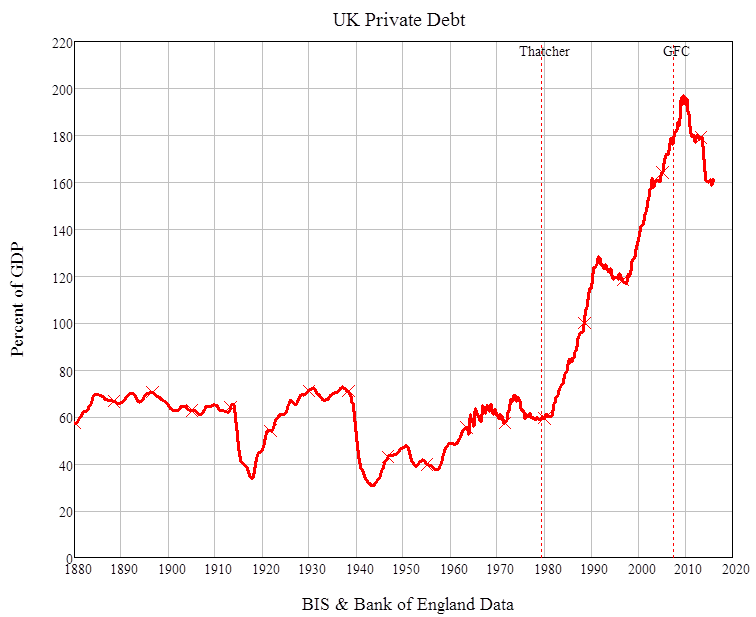
This conclusion vindicates Professor Steve Keen’s analysis years ago that the US/UK recoveries would be hampered by high levels of private debt, leading to a Japan like scenario.

To avoid this stagnation Steve Keen recommended only last year that goverments should be: “Writing off much of the private debt, and changing laws relating to mortgages and share ownership would be a good start. A certain amount of debt-financed investment and consumption is actually desirable in a growing economy, but while debt levels are as high as they are now thanks to the Ponzi Schemes of the last four decades, that debt-financed investment and consumption will be weak. They should also realise that a government deficit is a sensible policy most of the time in a growing economy.”

With the election of Jeremy Corby as leader of the Labour Party, there now seems to be a realistic possibility that the voters of England will be able to hear the truth about what has been going on before the next election from a party that stands a chance of being elected through our present electoral system. (Although, they won’t get much help from much of the mainstream media).

Learn more

I’ve found the works of Professor Steve Keen, Mitch Feierstein and Michael Hudson invaluable in gaining a better understanding of what is really going on. Sadly, you won’t (yet!) see any of the them interviewed at length on prime time UK television.